
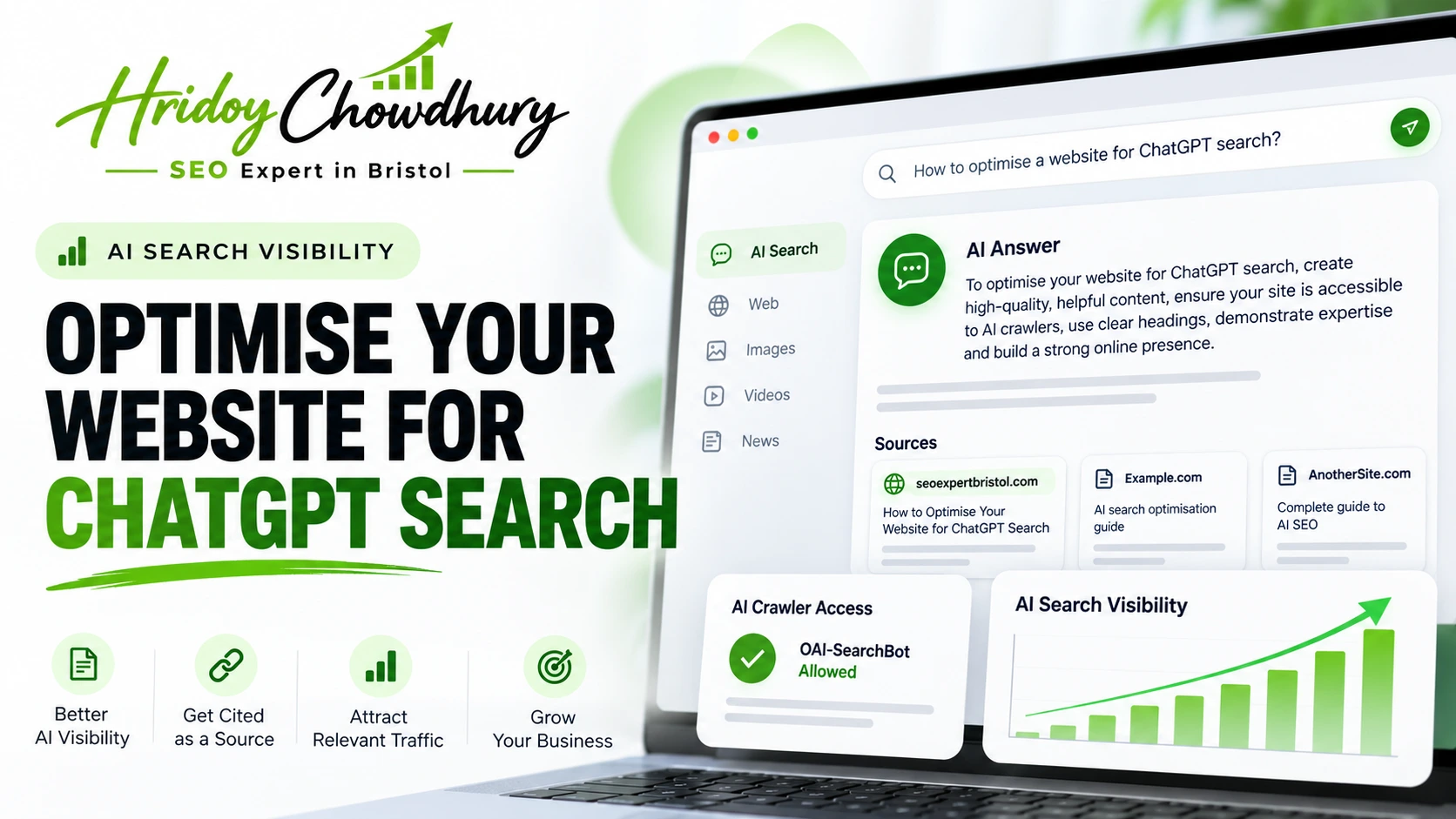
People are no longer relying only on Google to find information, products and services. They are also using AI-powered tools such as ChatGPT to research businesses, compare services and find answers.
If you want to know how to optimise website for ChatGPT, start by making your website accessible, publishing useful content and communicating your expertise clearly.
ChatGPT SEO is not about adding special AI tags or following a secret formula. It involves improving your website’s content, technical accessibility and online credibility to increase its opportunity to appear in AI-generated answers.
Here are 10 practical ways to improve your ChatGPT visibility and strengthen your website’s presence in AI search.
1. Understand How ChatGPT Search Works
ChatGPT Search helps users find current information from the web. Depending on the question, it may retrieve relevant webpages and include links to sources in its answers.
For example, someone might ask:
- Who provides SEO services for small businesses in Bristol?
- How can I improve my website’s Google visibility?
- What should I look for when choosing an SEO consultant?
ChatGPT may identify relevant websites and use their information to construct an answer.
However, allowing crawlers to access your website does not guarantee that your pages will be selected. ChatGPT Search visibility depends on the relevance of your content and the systems used to retrieve information.
It is also important to distinguish between ChatGPT Search visibility and AI model training. OpenAI provides separate crawler controls for these activities.
2. Allow OAI-SearchBot to Access Your Website
One of the first steps in ChatGPT search optimisation is checking whether your website allows OpenAI’s search crawler, OAI-SearchBot, to access its content.
Visit your robots.txt file:
https://yourdomain.com/robots.txt
If you want to allow OAI-SearchBot, a basic rule looks like this:
User-agent: OAI-SearchBot
Allow: /
Review your existing instructions before making changes. Also check whether your hosting provider, firewall or CDN prevents the crawler from accessing your pages.
OAI-SearchBot vs GPTBot
These crawlers have different purposes:
- OAI-SearchBot: Helps discover websites for ChatGPT Search.
- GPTBot: Crawls content that may be used to train OpenAI’s foundation models.
You can allow OAI-SearchBot while disallowing GPTBot, depending on your preferences.
Allowing the search crawler removes a potential access barrier but does not guarantee AI search citations.
3. Create Content That Answers Customer Questions
Useful content is an important part of AI search optimisation. Publish information that addresses the questions potential customers ask before choosing a product or service.
For example, an SEO consultant could write about:
- What does an SEO consultant do?
- How much does SEO cost for a small business?
- How long does SEO take to produce results?
- What is the difference between SEO, AEO and GEO?
These questions can become individual articles, detailed guides or sections within relevant service pages.
Answer the main question early. Avoid lengthy introductions that delay useful information. Start with a direct explanation, then expand with examples and practical advice.
Use descriptive H2 and H3 headings to organise your content. Each heading should introduce a useful topic rather than simply repeat a target keyword.
4. Make Your Content Clear, Specific and Original
AI search optimisation is not about writing exclusively for machines. Your content must remain useful to people.
Avoid vague statements such as:
“We provide innovative digital solutions to help businesses grow online.”
Instead, explain what you actually do:
“We review your website’s technical SEO, identify content gaps and recommend improvements to help search engines discover and understand your important pages.”
When creating content:
- Use clear, conversational language.
- Explain technical terms.
- Include practical examples.
- Support factual claims with reliable sources.
- Keep information accurate and updated.
- Remove unnecessary repetition.
Include genuine professional experience, original observations and real project examples. Never invent case studies or results.
5. Strengthen Your Website’s Technical SEO
Good content cannot perform as intended if search systems cannot access your important pages.
Review these essential elements:
- Crawling and indexing: Check robots.txt, noindex directives, canonical tags and server errors.
- Website structure: Organise related pages into logical sections.
- Internal linking: Connect supporting articles to relevant service pages using descriptive anchor text.
- Mobile experience: Ensure text, navigation, buttons and images work properly on mobile devices.
- Page performance: Identify loading issues that affect usability.
Use Google Search Console to monitor the indexing status of important URLs.
Remember that Google indexing and ChatGPT Search crawler access are separate considerations.
6. Make Your Business Information Clear and Consistent
Your website should explain who you are, what you offer and which customers you serve.
Include your business name, services, location, service areas, professional experience and contact information.
Create an informative About page explaining your professional background and working approach.
Keep business details consistent across your website and relevant professional profiles. If you serve customers remotely, explain this accurately rather than suggesting you have a physical office somewhere you do not operate.
Clear business information helps potential customers understand your expertise and supports your website visibility in ChatGPT.
7. Build Credibility Through External References
Your website is not the only place where people may discover information about your business.
Relevant industry publications, professional profiles, genuine customer reviews and credible external websites can help establish your online presence.
Focus on:
- Publishing useful industry insights.
- Contributing expert commentary.
- Building relationships with relevant organisations.
- Encouraging genuine customer reviews.
- Maintaining accurate professional profiles.
- Publishing original research and resources.
Avoid buying low-quality backlinks, creating fake reviews or manufacturing brand mentions.
The objective is to build an online presence that people can trust and verify.
8. Use Structured Data Where Appropriate
Structured data helps search engines interpret information on your website.
Depending on your content, relevant schema types may include Organisation, LocalBusiness, Service, Article, BreadcrumbList and Person.
Ensure your markup accurately reflects information visible on the webpage.
Structured data is useful as part of good SEO practice, but no special schema markup guarantees a ChatGPT citation. Use relevant markup rather than adding unnecessary code solely to target AI search.
9. Monitor Your ChatGPT Search Visibility
Optimisation should not stop after publishing content or changing technical settings.
Create a list of questions potential customers might ask.
For an SEO consultant serving Bristol businesses, examples include:
- Who provides AI SEO services in Bristol?
- How can a small business improve its AI search visibility?
- What should I look for when choosing an SEO consultant in Bristol?
Test these questions periodically using ChatGPT Search.
Record:
- Whether your business is mentioned.
- Whether your website is linked.
- Which pages are cited.
- Which competitors appear.
- Whether your business information is accurate.
Use consistent questions to compare observations over time. AI-generated answers can vary, so do not treat a few searches as a reliable ranking position.
Also monitor referral traffic from ChatGPT and other AI platforms through your website analytics. Review landing pages, engagement and enquiries where referral information is available.
Not every AI mention generates a website visit, so referral traffic alone cannot measure total ChatGPT visibility.
10. Avoid Common ChatGPT SEO Mistakes
Avoid these common mistakes when learning how to optimise website for ChatGPT:
- Blocking OAI-SearchBot: Review crawler and security settings.
- Publishing generic AI content: Prioritise original, useful information.
- Keyword stuffing: Use relevant search terms naturally.
- Adding irrelevant schema: Ensure markup reflects actual page content.
- Buying artificial mentions: Build genuine credibility instead.
- Expecting guaranteed citations: No legitimate SEO consultant can guarantee inclusion in every relevant ChatGPT answer.
- Ignoring traditional SEO: Technical accessibility and useful content remain essential.
ChatGPT SEO Checklist
| Area | What to Check |
| Crawler access | OAI-SearchBot is not blocked |
| Website security | Firewall and CDN allow intended access |
| Indexing | Important pages are accessible |
| Content quality | Pages answer customer questions |
| Content structure | Clear headings and organisation |
| Originality | Useful insights and examples |
| Internal links | Related pages are connected |
| Business information | Services and contact details are clear |
| Credibility | Experience and claims are verifiable |
| Structured data | Relevant and accurate markup |
| Mobile experience | Pages are easy to use |
| Measurement | Mentions, citations and referral traffic are monitored |
Frequently Asked Questions
1. How do I get my website to appear in ChatGPT Search?
Allow OAI-SearchBot to access your website, publish useful content, maintain a clear website structure and build a credible online presence. These practices improve discoverability but do not guarantee inclusion.
2. What is OAI-SearchBot?
OAI-SearchBot is OpenAI’s web crawler used to help surface websites in ChatGPT Search. It is separate from GPTBot, which crawls content that may be used for model training.
3. Is ChatGPT SEO different from traditional SEO?
ChatGPT SEO focuses on improving the opportunity for your website to be discovered and referenced in ChatGPT Search. Traditional SEO focuses on search engine visibility. Both benefit from accessible websites, useful content and credibility.
4. Does schema markup guarantee ChatGPT visibility?
No. Structured data helps describe webpage content, but there is no special schema markup that guarantees a ChatGPT citation.
5. Can small businesses benefit from ChatGPT SEO?
Yes. Small businesses can improve their visibility by publishing specialist content, explaining their services clearly and demonstrating genuine expertise. Quality and relevance matter more than publishing hundreds of articles.
How to Improve Your Website’s Visibility in ChatGPT Search
Learning how to optimise website for ChatGPT is not about finding a secret formula or adding a special AI tag to every page.
It is about making your website accessible, publishing information that genuinely helps people, communicating your expertise clearly and maintaining a credible online presence.
Treat ChatGPT search optimisation as an ongoing part of your wider SEO strategy rather than a one-time optimisation task.
If you want to apply these principles to your website, explore my AI SEO services to improve your visibility across traditional search and AI-powered search experiences.
About the Author
Hridoy Chowdhury is an independent SEO consultant who works directly with businesses on website visibility, technical SEO, content optimisation and AI search. He supports Bristol businesses remotely.
Further Reading and Official References